
Not so long ago, when prospects were looking for information, a provider or a solution to their problem, they just typed their search into Google.
Today, they can also ask ChatGPT directly.
And that changes something important for businesses: ranking well on Google doesn’t automatically mean being mentioned in AI answers.
So should you rethink your entire SEO strategy? Create content specifically for ChatGPT? Add FAQs all over your website?
Not necessarily.
To be visible on Google and ChatGPT, what matters most is understanding how these two tools find, understand and present your content. And figuring out which actions actually make sense for your business.
Here are six best practices to improve your visibility, without chasing the miracle recipes of AI search optimization.
Is being visible on Google the same as being visible in ChatGPT?
Not exactly.
On Google, search engine optimization (SEO) is mainly about making your pages accessible to search engines and getting them to rank for the right queries.
ChatGPT works differently. When it searches the web, it can draw on online sources to build its answer, and sometimes mention companies or cite pages.
So the goal isn’t just to show up in a list of results anymore, but also to be picked up as a relevant source in a generated answer.
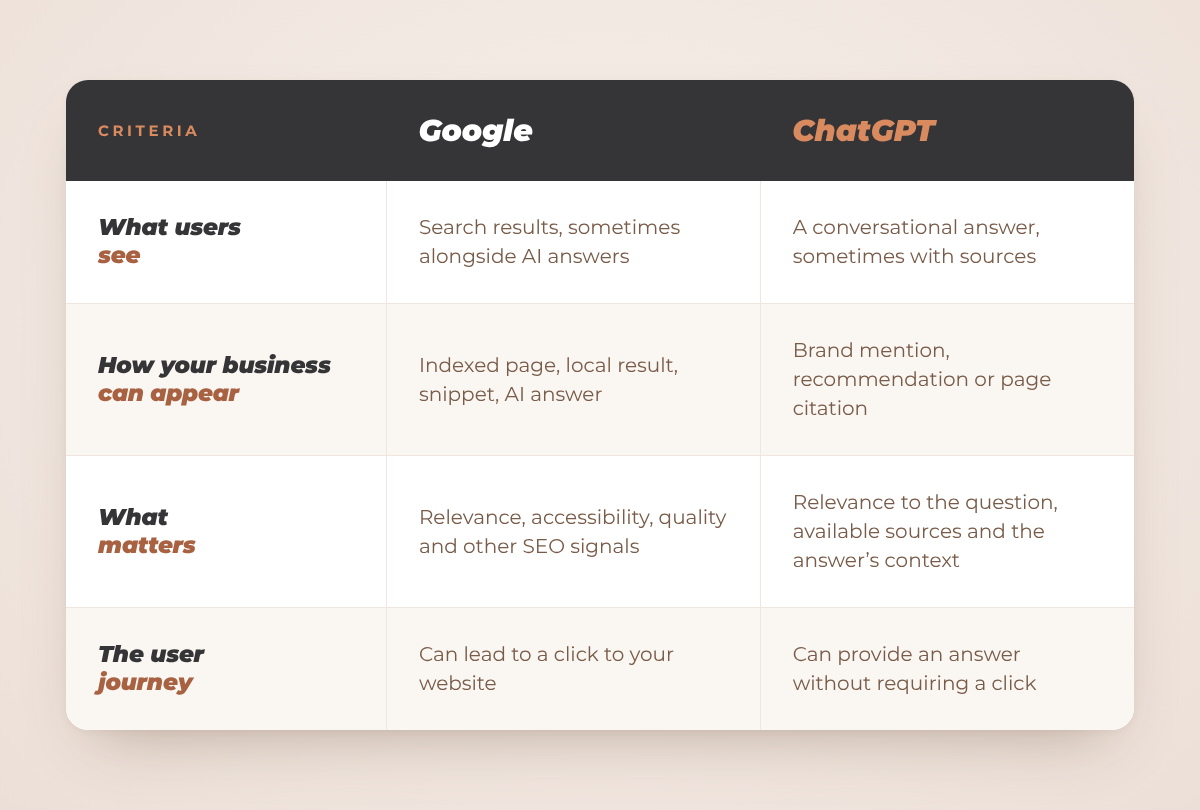
That said, the line between the two isn’t that clear: Google also includes AI features into its results, and ChatGPT can send users to web pages.
That’s exactly why I prefer to talk about SEO and GEO working together rather than systematically pitting one against the other.
If you want to dig into their differences, I break them down in my article SEO vs GEO: understanding the differences and best practices in 2026.
How can you improve your visibility on Google and in ChatGPT answers?
1. Make sure your website is accessible and easy to understand
Before trying to optimize your content for search engines and AI, they need to be able to access it.
It sounds obvious, but some pages can be hard to crawl, blocked by technical settings or missing from Google’s index.
Start by checking that your important pages are accessible, that their content reads properly and that they aren’t blocking indexing by mistake.
For Google, Google Search Console lets you check whether your pages are indexed and spot certain crawling issues.
On ChatGPT’s side, there are specific crawlers too.
OpenAI has two of them: OAI-SearchBot, used for search in ChatGPT, and GPTBot, which is associated with collecting content that may be used to train its models.
These are two different uses, with separate settings. Allowing one doesn’t mean allowing the other.
You can find this information in OpenAI’s official documentation on its crawlers.
Keep in mind that allowing OAI-SearchBot doesn’t guarantee you’ll be cited in ChatGPT. But blocking access to your pages can make you harder to discover.
So your first move isn’t to add some complicated GEO optimization, but to check that your website’s technical basics are in place.
2. Answer your prospects’ questions clearly
Let’s say you run a training company that helps small businesses with management skills.
You could publish an article called “Our management training programs” that presents your catalog.
But your prospects don’t necessarily search for your services with the same words you use.
They’re more likely to ask:
- How do you support an employee who’s just become a manager?
- Which management training is right for a small team?
- Should you train your managers in-house or hire an outside provider?
Those questions are real content opportunities.
On Google and in ChatGPT alike, the goal is to meet specific needs. So you’re better off building your content around your prospects’ real questions than creating more pages that repeat your list of services.
That doesn’t mean every question needs its own article. Several closely related questions can be covered in the same piece, as long as they share the same intent.
What really matters is understanding what the person wants to know and which answer would genuinely be useful to them.
3. Structure your content so it’s easy to understand
Good content has the right information, but it also needs to help readers find it easily.
And that starts with a clear structure.
A title that clearly states the topic, subheadings that organize the questions, easy-to-read paragraphs and concrete examples: all of that makes for a better read.
These elements also help search engines understand how your page is organized.
Take an article about choosing CRM software.
Rather than writing one long block of text that mixes features, pricing and selection criteria, you can organize your content around distinct questions: what is a CRM for, which criteria should you compare and which mistakes should you avoid?
A comparison table can also help when it lets readers see the differences at a glance.
On the other hand, adding an FAQ to every page or turning every paragraph into a list isn’t a GEO strategy.
Structure should serve the content, not the other way around.
And above all, it doesn’t guarantee that an AI will reuse your information. Mostly, it makes your page clearer and easier to use.
4. Bring expertise that generic content doesn’t have
This is probably the point I push hardest when I work on a content strategy.
Today, any company can ask AI for an article that explains the basics of a topic.
But if your content just rephrases what’s already on dozens of other websites, what does it really add?
Take two recruitment agencies publishing an article on the mistakes to avoid when hiring your first salesperson.
The first one lists general advice.
The second explains the mistakes it often sees with its clients, what those mistakes cost them and what it recommends depending on the situation.
Both articles can be useful, but the second has something more: its own experience and professional perspective.
That’s also what Google’s guidelines on helpful content emphasize, encouraging original information, first-hand experience and analysis that brings real value to the reader.
That doesn’t mean a personal opinion is enough to rank better or get cited in ChatGPT.
But sharing real examples, reliable data, analysis and lessons learned helps you create content that’s more distinctive and more credible.
If you’re not sure where to start, I explain how to turn your expertise into content that attracts clients.
Your website is visible, but your content doesn't really reflect your expertise? I help you build an SEO/GEO content strategy that starts from your business goals, your market and your expertise to find the topics where you actually have something to say.
5. Strengthen the credibility and consistency of your online presence
Your website isn’t the only place where people can discover your business.
Your LinkedIn profile, articles published on other websites, interviews, relevant professional directories and brand mentions all contribute to your online presence too.
The goal isn’t to create profiles everywhere or to pile up artificial links.
The idea is rather to make your business easy to identify and to keep the information people find about it consistent.
On your own website, that comes down to simple things: saying who you are, explaining your expertise, showing who writes your content when it’s relevant and presenting verifiable work.
Outside your website, speaking in a specialized publication, a professional talk or a relevant mention can help raise awareness of your business. That’s actually the whole point of personal branding for B2B leaders.
Keep in mind, though: a mention on a third-party website doesn’t guarantee you’ll appear in ChatGPT.
You need to tell the difference between best practices that strengthen your presence and credibility, and the exact way AI tools pick their sources, which isn’t fully public.
6. Measure your visibility without focusing only on Google rankings
So how do you know if all this is working?
For Google, you have fairly well-established tools. Search Console shows you impressions, clicks and the queries that bring you visibility.
You can also look at organic traffic and conversions to see which pages actually help your business.
For ChatGPT, measurement is less standardized.
You can run tests with questions similar to your prospects’, check whether your business is mentioned or some of your pages are cited, and track visits coming from ChatGPT in your analytics.
But take these results with a grain of salt: an answer can change depending on how the question is phrased, the context or the sources consulted.
Being cited once doesn’t mean you’re visible on a regular basis.
And on the flip side, not showing up in a few tests doesn’t mean your whole GEO strategy needs rethinking.
The most important thing is to connect these observations to concrete results: is your content reaching the right people, driving relevant visits and contributing to your business goals?
Which mistakes should you avoid if you want to appear in ChatGPT answers?
With the rise of AI search optimization, a lot of advice gets passed around as shortcuts to get cited by ChatGPT.
Some of it deserves a closer look.
Believing there’s a magic formula. Adding FAQs, structured data or a specific file to your website doesn’t guarantee ChatGPT will recommend you. They can be useful technically, but none of them guarantees you a spot in AI answers.
Producing dozens of generic articles with AI. Publishing more doesn’t mean publishing better. If all your articles repeat the same information without adding value, you mostly risk diluting your expertise.
Giving up on SEO to focus only on GEO. It would be a mistake to set aside your website’s accessibility, page quality, search intent and SEO basics. All of that still matters for being discovered on the web.
The point isn’t to choose between Google and ChatGPT, but to build a presence solid enough to be found, however your prospects search.
A content strategy designed to be found, understood and chosen
Being visible on Google and ChatGPT isn’t about following two completely different recipes.
They don’t work the same way, but the basics are shared: an accessible website, content that answers real questions, identifiable expertise and reliable information.
SEO builds your presence in search engines. GEO pushes you to think about how your content can also be discovered, understood and sometimes cited in AI answers.
But in both cases, visibility is only part of the job.
Being found is good. But you still need to give the right people a reason to trust you and choose you.
That’s why an SEO/GEO strategy also needs to be part of a broader reflection on your business, your clients and your goals. I cover this topic in my article How do you build a content strategy that serves your business goals?.