

You spend your days advising clients, solving their problems and answering their questions.
But as soon as you need to create content for your business… your mind goes blank.
Either you don’t know what to talk about. Or you have plenty of ideas, but no clue which ones your future clients will actually care about.
And yet, the material is already there. It’s in your conversations, your experience, your convictions, and all those things that feel so obvious to you that you don’t even think of sharing them.
Turning your expertise into content is really about making it useful, clear and interesting for the people you want to attract.
So how do you get from what you know to content that makes people want to work with you?
Why isn’t being an expert in your field enough to attract clients?
You can be great at what you do and still have a hard time showing it.
Simply because knowing your subject and knowing how to talk about it to prospects are two different skills.
Take an energy efficiency engineer. She knows energy audits, insulation and building codes inside out. But if her content stays very technical, the owner of a small manufacturing company may not get what it actually changes for their business.
On the other hand, content about energy bills, common renovation mistakes or what a poorly insulated building really costs is much more likely to get their attention.
The expertise is the same. What changes is the way it’s presented.
And that’s often where businesses miss out: they talk about what they know, without connecting it to what their clients actually care about.
How do you turn your expertise into content your future clients care about?
1. Start from your clients’ questions and problems
When you’re looking for content ideas, the first instinct is to ask yourself: “What could I talk about?”
I’d start from a different question instead: “What are my clients trying to understand or solve?”
Think back to your last meetings, your sales calls or the questions you get by email.
Which questions keep coming up? What do your prospects misunderstand? Which mistakes do you see often? What’s stopping them from taking action?
All of these situations can become content topics.
For example, an HR consultant could write an article on why small businesses struggle to retain their employees, rather than publishing generic content about the importance of human resources.
The difference? In the first case, they start from a problem their prospect recognizes right away.
And that works a lot better than picking a topic just because it’s trendy.
2. Identify what your experience lets you bring to the table
Once you’ve found your topic, there’s one important question left: what can you bring that your reader won’t find in ten other pieces of content?
That’s where your experience matters.
Your observations in the field, your convictions, the mistakes you’ve seen, the decisions you’ve made, the advice you keep giving your clients: that’s exactly what makes content interesting.
Let’s say you want to talk about the mistakes to avoid during a website redesign.
You could write a very standard article with the usual recommendations. Or you could explain the mistakes you’ve actually seen with your clients, why they cause problems and what you recommend to avoid them.
In the second case, your content gives useful information, but it also shows how you work.
That’s an approach the Content Marketing Institute advocates in its article on getting the most out of subject matter experts: conversations with specialists bring out observations, experiences and points of view that don’t necessarily come through when you simply ask them to write content.
In other words, you don’t need to come up with new topics. Mostly, you need to look differently at what you already know.
3. Turn a technical topic into a clear message
It’s a fairly common trap when you know your job really well: you forget that your reader doesn’t necessarily have the same knowledge.
As a result, you use technical terms, acronyms and concepts that seem obvious to you but make the content harder to read.
Making your expertise accessible doesn’t mean oversimplifying it or losing credibility.
It’s about using the right words for what your reader already knows.
For example, instead of opening with a detailed explanation of Core Web Vitals, an SEO expert could start from a more concrete question: “Why can a slow website put off your visitors before they even discover your offers?”
Then they can get into the technical side needed to understand the problem.
You’re not taking anything away from your expertise. You’re just giving the reader a good reason to care about it.
This is also in line with Google’s guidelines on helpful, people-first content, which encourage original information, first-hand experience and content that genuinely meets readers’ needs.
4. Choose the right angle and the right format
The same expertise can be presented in different ways.
Take an accountant who notices that many business owners confuse profitability and cash flow.
They could write a blog article explaining the difference in detail, a LinkedIn post sharing a mistake they come across regularly, or an FAQ on their website answering a specific question.
Same starting topic, but the angle and format change depending on what they want to give the reader.
So before you start, ask yourself three questions:
- Which specific question should this content address?
- Who is it for?
- Which format is best suited to provide a useful answer?
No need to repurpose every idea across all your channels. Just pick the format that best serves your message.
You have the expertise, but you struggle to find the right topics and organize your communication? That's exactly what we clarify together with the Point Zero Diagnostic: we review your current communication and pinpoint the most relevant ways to showcase your expertise.
5. Connect your content naturally to your offer
A piece of content can be interesting, useful, get people talking… and still bring you zero clients.
Why? Because readers don’t always see the link between what you share and what you offer.
Picture a consultant who regularly publishes fascinating analyses of their industry, but never talks about the problems they help their clients solve.
Their audience may enjoy their posts without thinking of them the day they need help.
This isn’t about turning every piece of content into an ad. The idea is for your expertise to be associated with the problems you can actually help with.
For example, you can illustrate your advice with situations you’ve encountered in your work, explain your approach or point readers to a service when it’s a logical next step after reading.
Your readers need to understand what you master, but also in which situations they might need you.
Example: how expertise becomes content that speaks to a prospect
To make this more concrete, here are a few examples of expertise turned into content topics.
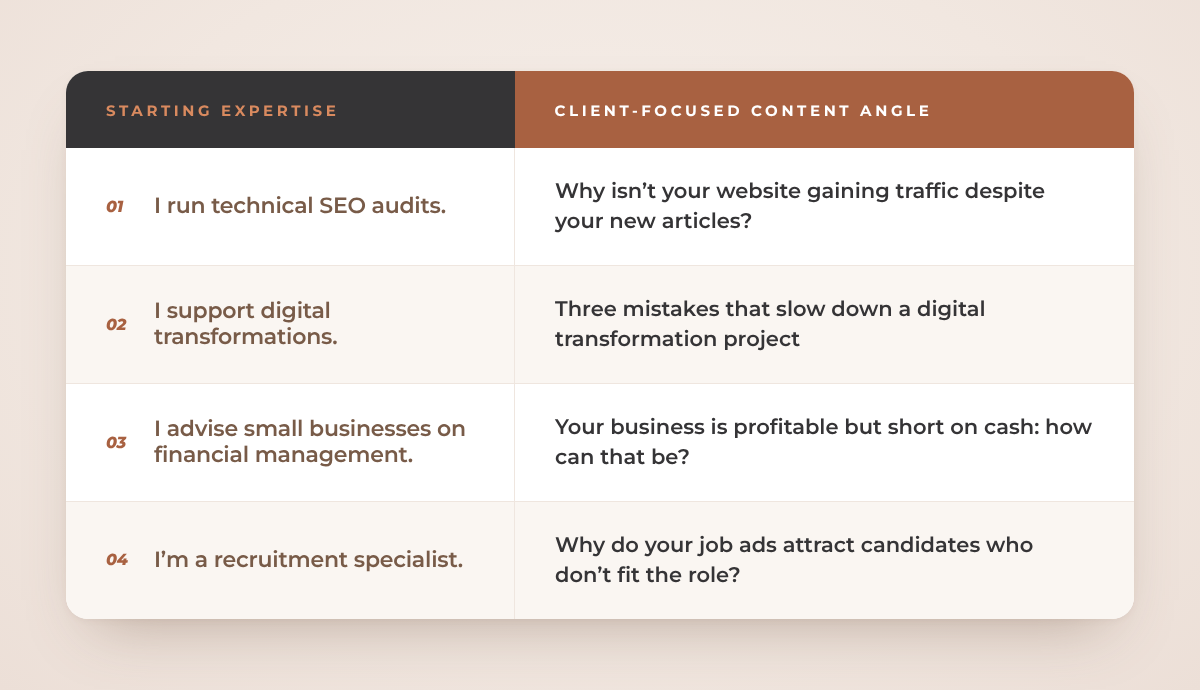
In each example, the expertise stays the same. But instead of starting from the service, you start from a question or a difficulty the client may face.
And it’s often this shift in perspective that makes content more interesting.
Keep in mind, though: a good angle isn’t enough. Behind it, you need a genuinely useful answer, shaped by your experience and adapted to your reader’s level.
The trap: creating interesting content that’s disconnected from your business
One last thing to keep in mind: an interesting topic isn’t necessarily a relevant one for your business.
You probably have a lot to say about your job, your industry or entrepreneurship in general. But if your content never makes it clear what you do and who you work with, you risk attracting an audience that has little to do with your future clients.
That’s why I don’t recommend building your communication from a simple list of post ideas.
Before producing content, you need to know what you want to achieve and where each topic fits in your communication.
I explain this thinking in my article: How do you build a content strategy that serves your business goals?
The point isn’t to talk only about your offers, but to build a consistent presence where your content helps people understand what you bring.
Your expertise is already raw material for your content
No need to invent new expertise to create interesting content. You probably already have plenty of knowledge, experience and ideas worth sharing.
The real work is spotting the ones that match your prospects’ concerns, finding the right angle to make them accessible and connecting them to your business.
Good content shows you know your subject, but above all it should help your reader see how your expertise can be useful to them.