
Posting three times a week on LinkedIn, writing two blog articles a month, sending a newsletter every other week… On paper, it looks like well-organized communication.
But do you really know what all that content is supposed to bring to your business?
I think it’s an essential question, because I still see a lot of companies focusing on the topics to publish, the formats to test or the frequency to keep up, without really defining what they’re trying to achieve.
And of course, when you don’t know exactly where you want to go, it’s hard to tell whether all that effort is actually paying off.
A content strategy isn’t just a well-filled editorial calendar. It’s the thinking that connects your communication to your business goals, taking into account your audience, your expertise and the resources you have.
So where do you start to build a content strategy that’s consistent and, above all, useful for your business?
What is a content strategy?
A content strategy is the set of decisions that define why you communicate, who you’re talking to, which messages you want to get across and how your content can help grow your business.
In practice, it connects your business goals, your audience’s needs and what your company genuinely has to offer.
People often mix up three related ideas that don’t mean exactly the same thing:
- The content strategy sets the overall direction and the role content should play in your business.
- The editorial strategy turns that direction into topics, angles, messages and formats.
- The editorial calendar organizes how content is produced and published.
The boundaries between these ideas can vary from one company to another, but the principle stays the same: the calendar is an execution tool, not a strategy on its own.
You can publish regularly, have a nice editorial line and still not get the results you hoped for. Not necessarily because your content is bad, but because it doesn’t address the right issues.
How do you build a content strategy in 7 steps?
1. Understand your business and define your goals
When I start working on a content strategy, I don’t ask the client right away how many posts they want to publish each week.
First, I try to understand their business as a whole: what they sell, to whom, which offers are a priority, how they find clients today, what works in their communication and what’s causing problems.
I also look at their positioning, their ambitions and the messages they’d like to bring forward. Basically, anything that helps me understand the business before we start talking about content.
Why? Because a company launching a new offer doesn’t have the same needs as a well-established company that struggles to convert its prospects.
In the first case, you may need to build visibility and get the offer known. In the second, the problem might come from unclear messaging, a positioning that doesn’t stand out, or content that doesn’t address prospects’ objections enough.
And in that case, publishing more won’t necessarily fix the problem.
So the starting point is to identify what your communication needs to help improve in your business. That could be awareness, lead generation, understanding of your offers, trust or loyalty.
Once that goal is clear, it becomes much easier to make consistent editorial decisions.
2. Understand your audience and the messages it needs to hear
Knowing your target is good. Understanding what’s going on in their head is even better.
And for that, knowing their age, job or industry isn’t always enough.
What I’m most interested in is understanding the problems the people you’re talking to are facing, the questions they ask themselves, what holds them back and what could lead them to trust your company.
For example, if you sell consulting services, your prospects don’t necessarily want to understand every subtlety of your job. Mostly, they want to know whether you understand their problem, whether you can help them and what makes you different from other providers.
This is also the moment to do real work on the messages you want to highlight.
Because as a company, we sometimes tend to talk about what we know best: our services, how we work, what’s new… Except that’s not necessarily what interests the people we’re trying to reach the most.
A good content strategy therefore has to strike the right balance between what you want to say and what your audience really needs to understand.
And to feed that thinking, your sales conversations, your clients’ questions or the objections you hear regularly are often excellent sources of information.
What if the problem wasn't your content, but your strategy?Before producing more, it's sometimes worth looking at what already works, what's missing and what could be improved in your communication.
3. Define content pillars that match your expertise
Once you know where you want to go and who you’re talking to, you can start structuring the topics your company will speak about.
That’s the role of content pillars: the main themes that will guide your content creation.
Take the example of a cybersecurity company. It could build its pillars around risk prevention, employee awareness, industry changes or its hands-on expertise.
But careful, the idea isn’t to pick four themes at random just because they relate to your business.
Each pillar needs a real purpose: meeting your audience’s needs, showcasing your expertise and contributing to your goals.
It’s also the right time to think about what sets you apart. What can you bring that your competitors don’t? Do you have a particular approach, convictions, experiences or concrete examples that deserve more attention?
Because we can all talk about the same topics. However, the way you handle them, the examples you use and the point of view you bring can make all the difference.
4. Define the role of your content in the customer journey
This is something I insist on a lot: not all your content needs to sell, or even to generate as much visibility as possible.
A blog article can help someone who doesn’t know you yet discover you. A case study can reassure a prospect who’s hesitating between several providers. A more personal post can help people understand your vision and make them want to work with you.
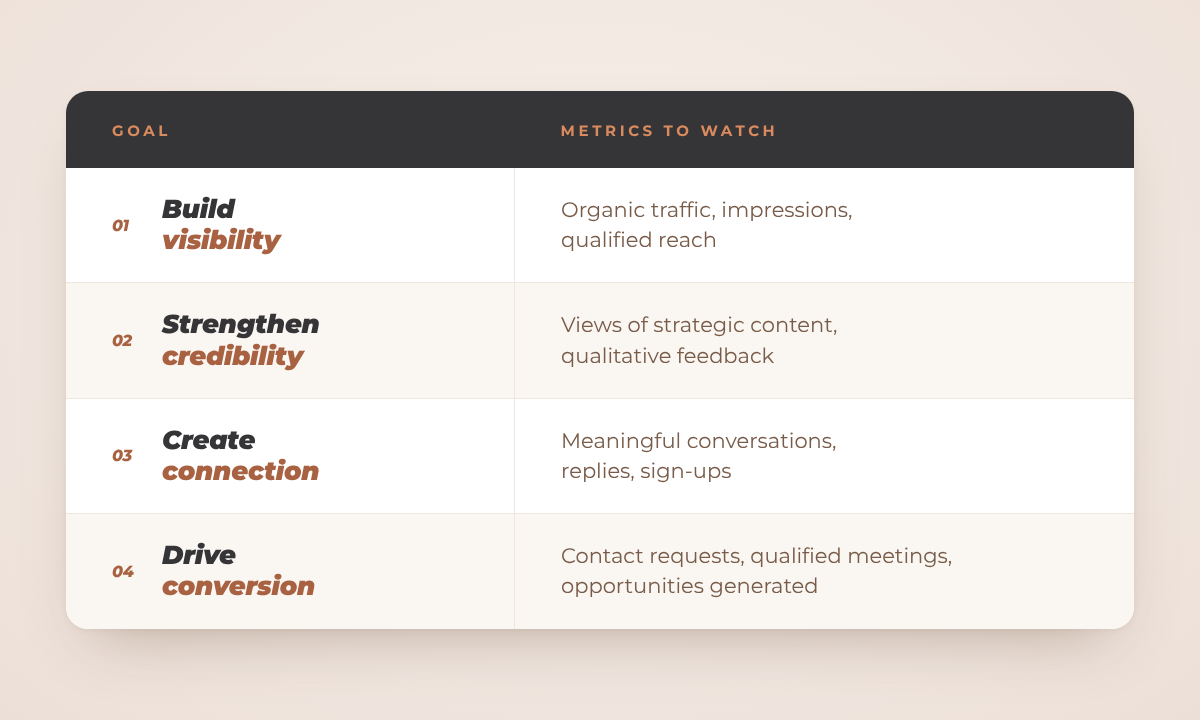
In my approach, I focus on three dimensions in particular: visibility, credibility and connection. They help you think about the place each piece of content can take in your audience’s journey, without reducing all your communication to views or immediate sales.
The idea isn’t to put every post in a rigid box, but to know what you’re trying to trigger.
And it changes quite a lot in the way you build an editorial strategy. Instead of only looking for post ideas, you start thinking about the content that’s missing to guide people from discovering your company all the way to their decision.
If you want to dig deeper into this, I created a resource to better understand the role of each piece of content in your communication.
That’s also why I think it’s important not to judge all content by the same metrics. A post with little engagement may well have played a key role in a prospect’s decision.
5. Choose the right channels and build a consistent ecosystem
LinkedIn, Instagram, blog, newsletter, podcast… There’s no shortage of options, and that’s exactly what can make choices difficult.
But your company doesn’t need to be everywhere. Above all, it needs to be present where it makes sense for its audience and its goals.
A blog built for SEO can help you answer your prospects’ searches and grow your visibility on Google. GEO can also come into play to make your content easier for AI-powered search engines to understand and use.
Social media can be useful to share your expertise, spread your ideas and spark conversations with your audience. A newsletter can then help you nurture the relationship with people who already know your company.
But rather than thinking about each channel separately, I prefer to think in terms of a content ecosystem.
For example, a blog article can be the starting point for several LinkedIn posts. A question a prospect keeps asking can become an SEO article. And an idea shared on social media can be explored further in a newsletter.
We’re not talking about copy-pasting the same text everywhere, but about moving ideas around intelligently between channels.
It’s often more relevant than constantly creating new content from scratch. And above all, it keeps your communication consistent, even when formats change.
6. Build a realistic editorial calendar
Now that we’ve defined the goals, the audience, the messages, the pillars and the channels, we can finally talk about the editorial calendar.
And at this stage, it becomes much easier to build, because you’re no longer just trying to fill slots.
For each piece of content, you can define the topic, the angle, the target, the goal, the format and the distribution channel. You can also identify the resources needed and organize production according to your priorities.
One piece of advice: don’t build your calendar only around what you’d ideally like to publish. Also take into account the time and means you actually have.
If your team can produce two good pieces of content a month, it’s better to start there than to plan fifteen posts that will end up rushed or abandoned.
And stay flexible. A content strategy isn’t meant to lock you into a schedule that’s impossible to change. If a new issue comes up with your clients or a topic becomes particularly relevant, you should be able to fit it in.
The calendar should help you apply your strategy, not become one more constraint.
7. Measure results and adjust your strategy
A content strategy isn’t finished once the posts are scheduled. You also need to take the time to analyze what they bring to the business.
And here again, everything depends on your initial goals.
If you want to improve your visibility, you can track organic traffic, impressions or your presence on certain searches.
If you want to strengthen your credibility, you can look at how often your in-depth content is read, qualitative feedback or the questions prospects ask you after discovering your work.
And if your priority is acquisition, contact requests, qualified meetings and sales opportunities become especially worth tracking.
Of course, a prospect’s journey isn’t always linear. They can discover your company through an article, follow you on LinkedIn for several weeks, then contact you after visiting your website.
That’s why you should avoid analyzing each channel in isolation or jumping to conclusions based on a single metric.
And above all, don’t confuse popularity with business performance. A piece of content that attracts 200 people genuinely interested in your services can be worth more than one that gets 20,000 views from an audience that isn’t a fit.
If you’re struggling to see what really works in your communication, you can also start by reviewing your current strategy.
A concrete example: going from a business goal to a content strategy
Imagine a B2B company that offers consulting services. It has a website, posts regularly on LinkedIn and writes a few blog articles.
Even so, sales inquiries remain fairly rare.
Its first reflex might be to produce more content, thinking that with more posts, it will eventually reach more people.
Except when you analyze its communication, you notice its content mostly talks about company news, its services and fairly generic advice. It says little about how it works, its experience or the concrete problems it solves.
So the problem may not be the amount of content, but rather what the current content helps people understand about the company.
In this situation, a better-suited strategy could work on several fronts:
- Visibility, with SEO articles that match its prospects’ searches and problems.
- Credibility, with analyses, project examples and content that shows its expertise.
- The relationship with its audience, by giving more room to people, convictions and conversations.
- Conversion, by clarifying the offers and making it easier to move from content to the site’s key pages.
The next step would be to prioritize these actions based on available resources, rather than trying to do everything at once.
This example is fictional, but it shows what a content strategy is for: identifying what’s really missing in your communication before deciding what to produce.
The mistakes that keep a content strategy from working
Even with a well-organized calendar and a motivated team, some mistakes can limit results.
The first is publishing without a clear goal. You pick topics because they’re trending, because a competitor talks about them or because you absolutely have to post something this week. The problem is that you end up producing a lot without building truly consistent communication.
The second is trying to talk to everyone. By trying to reach too broad an audience, your messages become generic and lose their appeal for the people you really want to attract.
There’s also focusing too much on production. You spend time finding ideas, writing, creating visuals and scheduling posts, but rarely stop to ask whether the topics and angles you chose are still relevant.
Finally, be careful about measuring only what’s easy to measure. Views, impressions and followers can be useful, but they’re not enough to tell whether your strategy is really contributing to your business goals.
A good content strategy therefore requires as much thinking upfront as analysis after publishing. And sometimes, the best adjustments aren’t about adding new content, but reworking what already exists.
Above all, a content strategy has to make sense for your business
Building a content strategy doesn’t mean applying a ready-made method or copying what works for your competitors.
It means taking the time to understand your business, your goals, your audience and what really deserves to be highlighted in your communication. Then you can make consistent choices about topics, formats, channels and the metrics to track.
And that’s also why I believe a good content strategy isn’t about publishing more. Sometimes you need to create new content. Sometimes you mostly need to rework your messages, make better use of your expertise or create more connections between your existing channels.