
Your company has a website, a LinkedIn page, a well-defined brand identity and maybe even a content strategy already in place. But if I asked your prospects who’s behind your company, would they be able to answer?
It’s an interesting question, because in B2B, we often put a lot of weight on the company’s communication, but sometimes much less on the people who lead it.
And yet, behind every company there are people, experiences, convictions and a way of seeing things. Those are exactly the things that can make the difference when a prospect is trying to understand who they’re dealing with.
That’s the whole point of B2B personal branding: helping a leader build their professional reputation while contributing to their company’s visibility and credibility.
But in practice, why should a CEO or a founder speak up? And is it really useful when the company already communicates?
What is personal branding for a B2B leader?
Personal branding is about building and growing a professional reputation around your expertise, your background, your convictions and the way you work.
For a B2B leader, the goal isn’t necessarily to become a public figure or share your life on social media. It’s more about making the person behind the title visible, and showing what they bring to their company.
A leader can, for example, share their take on a market shift, explain the decisions that shaped the company’s growth or offer their perspective on the problems their clients face.
This kind of content helps people understand their vision, their expertise and sometimes even their personality, without necessarily getting into their private life.
And contrary to what you might think, personal branding isn’t limited to posting on LinkedIn. It can also grow through conferences, interviews, podcasts, articles or simply the way someone takes part in their industry.
So the idea isn’t to be visible for the sake of it, but to build a reputation that matches what you actually do.
Why is personal branding valuable for a leader and their company?
1. Humanize the company and give it a recognizable voice
A company can have very professional communication, a perfectly built website and well-presented offers, and still come across as fairly impersonal.
That’s especially true in B2B, where companies often use institutional language and messages that end up sounding the same.
The leader can bring something else: a voice, a personality, a point of view.
Take a digital transformation consulting firm. On its LinkedIn page, it can present its services, announce new projects or share industry news.
Its leader, on the other hand, can explain why some transformations fail based on their experience, share what they’ve learned while working with clients or voice a conviction about where the profession is heading.
Same company, same industry, but not the same angle.
Corporate communication presents the company. A leader’s voice also helps people understand the people and the vision that move it forward.
And in industries where several providers offer fairly similar services, that human dimension can help you stand out.
2. Make visible an expertise that doesn’t always come through in corporate communication
When you run a company, you often build up an impressive amount of experience, observations and knowledge about your market.
The problem is that a large part of that expertise stays invisible.
It comes out in client meetings, sales conversations, internal meetings or discussions with partners. But it isn’t necessarily used in the company’s communication.
That’s a shame, because those insights may be exactly what interests the people you’re trying to reach.
The head of an IT company can share their analysis of how their clients’ needs are changing. An agency founder can explain why they turn down certain requests. A CEO in manufacturing can shed light on the challenges their industry is facing.
This kind of content goes beyond visibility: it shows how you think, what you master and what sets you apart.
And that’s also where you need to be careful not to confuse personal branding with content production.
Posting generic leadership advice or repeating the latest trends in your industry isn’t necessarily enough to build an interesting professional reputation.
What matters is what you personally bring to the conversation.
3. Build trust before the first sales conversation
In B2B, some buying decisions take time. Prospects may compare several providers, read different content, ask for recommendations and try to understand who they’re thinking of working with.
A leader speaking up can play a part in that research phase.
Imagine a prospect who discovers your company, then comes across several posts from its founder. They find relevant insights, concrete examples and a vision that matches their own challenges.
When they eventually get in touch, they may not have all the answers to their questions yet, but they’ll already have an idea of how you work and how you think.
This is especially valuable for companies that sell consulting, complex services or support where the human relationship plays an important role.
Of course, personal branding doesn’t replace proof of results, client references or the quality of your services. But it can add one more element to building trust.
You have expertise to share, but not necessarily the time to create your content? That's exactly the point of personal branding and LinkedIn ghostwriting support: turning your ideas, your experience and your vision into posts that sound like you, without adding all the content production to your schedule.
4. Create opportunities beyond visibility
Personal branding can also open doors that don’t come directly through a quote request.
A relevant post can catch the attention of a potential partner, make an event organizer want to invite you to speak, or help a future hire discover your company.
It can also make some sales conversations easier. A prospect who regularly follows your insights will already have what they need to understand your expertise before your first conversation.
But be careful not to measure the value of personal branding only by views or followers.
A leader can have a relatively small audience made up of decision-makers, partners or professionals directly concerned by their business. On the other hand, very popular posts don’t necessarily turn into business opportunities.
So the question to ask isn’t only “how many people see my content?”, but rather “do the right people better understand what I do and why they could trust me?”
Personal branding and corporate communication: why should they work together?
Growing a leader’s voice doesn’t mean putting the company’s communication aside. The two play different roles, and that’s exactly what makes them interesting when they’re well connected.
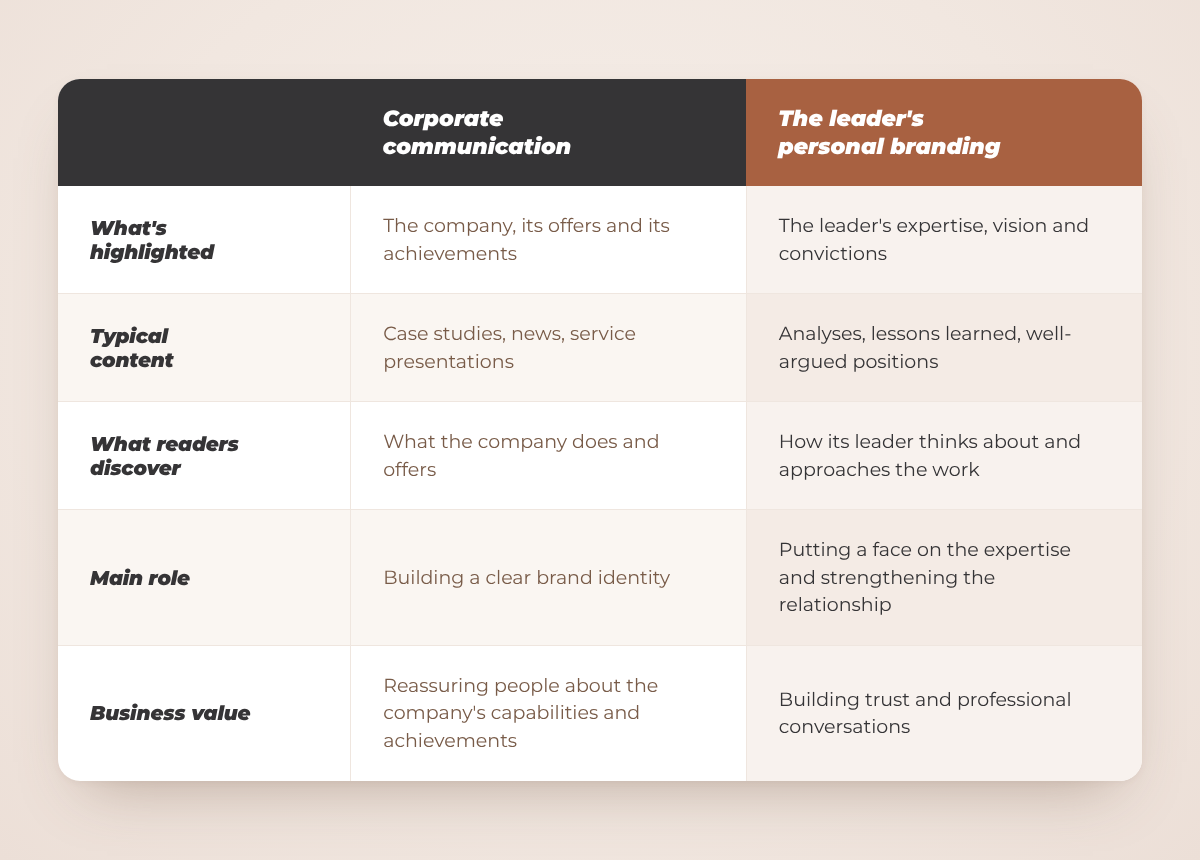
So the idea isn’t to choose between them, but to understand what each one can bring.
A consulting firm could, for example, publish a case study on its LinkedIn page while its leader shares the lessons learned from that same project. Two different angles, but communication that stays consistent.
That’s also why I believe personal branding should be part of a broader reflection on the company’s content strategy.
The point isn’t to turn the leader into a billboard for their own company, or to ask them to share every corporate post. The goal is rather to identify what they can personally bring to the communication, while staying consistent with the company’s business challenges.
It’s a topic I cover in my article on building a content strategy aligned with your business goals. Before choosing formats and channels, you need to know what your content is supposed to bring to the business.
Do you have to post on LinkedIn to build your personal brand?
No, it’s not mandatory. But if you lead a B2B company, LinkedIn is clearly one of the first channels I’d recommend exploring.
And for a fairly simple reason: unlike social networks geared more toward entertainment or personal use, LinkedIn is built around professional relationships.
You’ll find leaders, decision-makers, marketing managers, salespeople, recruiters and plenty of professionals who also come to follow changes in their industry, exchange ideas and grow their network.
That makes it a particularly relevant place to share your expertise and connect with people who may have a professional interest in your business.
But being present on LinkedIn doesn’t mean posting every day.
I’d much rather see a leader regularly share interesting thoughts about their work than post generic content five times a week just to stay active.
And above all, there’s no need to turn every post into personal storytelling. You can talk about your professional experiences, your vision, the decisions you make, the questions you ask yourself or the changes in your market.
Personal branding doesn’t require you to expose your private life. It’s about finding a way of speaking up that fits you and brings something to your audience.
That’s actually the approach I try to apply on my own LinkedIn profile, where I share my thoughts on content strategy, SEO, AI and communication, based on my experience and my professional convictions.
So LinkedIn remains a particularly valuable lever in B2B, but it’s not the only one. Depending on your business, conferences, interviews, podcasts or contributions to specialized media can also help build your reputation.
The most important thing is to choose channels and formats you can genuinely commit to over time, rather than forcing yourself into a presence that ends up becoming a chore.
Speak up, yes, but to say something that matters
B2B personal branding isn’t just about making a leader more visible. Its value lies in showcasing an expertise, a vision and a personality that can also contribute to the company’s reputation.
And for that, you don’t need to become an influencer, share your life story or post at all costs.
What you do need is something to bring to the conversation, an understanding of who you’re talking to and a clear idea of what you want to build through your voice.
Because deep down, the problem for many leaders isn’t that they lack interesting things to say. It’s that they don’t always know how to turn their experience and ideas into content that’s relevant to their audience.