
For a while now, it’s been hard to talk about online visibility without hearing about GEO. With ChatGPT, Perplexity, Gemini and the AI-generated answers built right into Google, search habits are changing. So inevitably, one question keeps coming up: is SEO still enough?
Some people even go as far as saying that organic search became obsolete overnight.
Except it’s a bit more nuanced than that.
SEO (Search Engine Optimization) and GEO (Generative Engine Optimization) address different visibility challenges, but they also share the same fundamentals. And above all, they don’t have to compete with each other.
So what are the real differences, what does AI change in the way people find you online, and which best practices actually matter in 2026?
SEO and GEO: what are we actually talking about?
SEO: improving your visibility in search engines
SEO, or organic search optimization, covers everything that helps a website show up in the non-paid results of search engines like Google or Bing.
The goal is to get your pages in front of people when they search for something related to what you do.
Let’s take an example. You run a cybersecurity company and you publish an article about phishing risks in the workplace. With solid SEO work, that article can show up when someone searches “how to protect my business from phishing”.
If your content answers their question, that person may click through to your site, discover your expertise and maybe take an interest in your services.
SEO has several dimensions: technical health, content, site structure and the signals that build credibility. But the principle stays simple: help the right people find your content when they’re looking for information, solutions or services.
GEO: improving your presence in AI-generated answers
GEO, for Generative Engine Optimization, refers to the practices that aim to improve the visibility of a brand, a business or its content in the answers produced by generative AI systems.
The difference is that the user doesn’t necessarily browse a list of results to find the answer themselves. They can ask an AI assistant a question and get a summary built from the information the system has or the sources it checks.
Back to our cybersecurity company. A prospect could ask ChatGPT or Perplexity: “What are the best practices to protect a small business against phishing attacks?”
The AI could then write an answer, cite certain websites or recommend additional resources.
The goal of GEO is to make your expertise and your content part of these new search journeys. That can mean a citation with a link, a mention of your company or a piece of information picked up in an answer, depending on the platform and how it works.
One word of caution though: optimizing content for GEO doesn’t guarantee it will be cited by ChatGPT, Gemini or any other AI. Answers vary depending on the system, the question and the sources used.
SEO vs GEO: what are the main differences?
The easiest way to understand the difference between SEO and GEO is to compare what each approach is trying to improve.
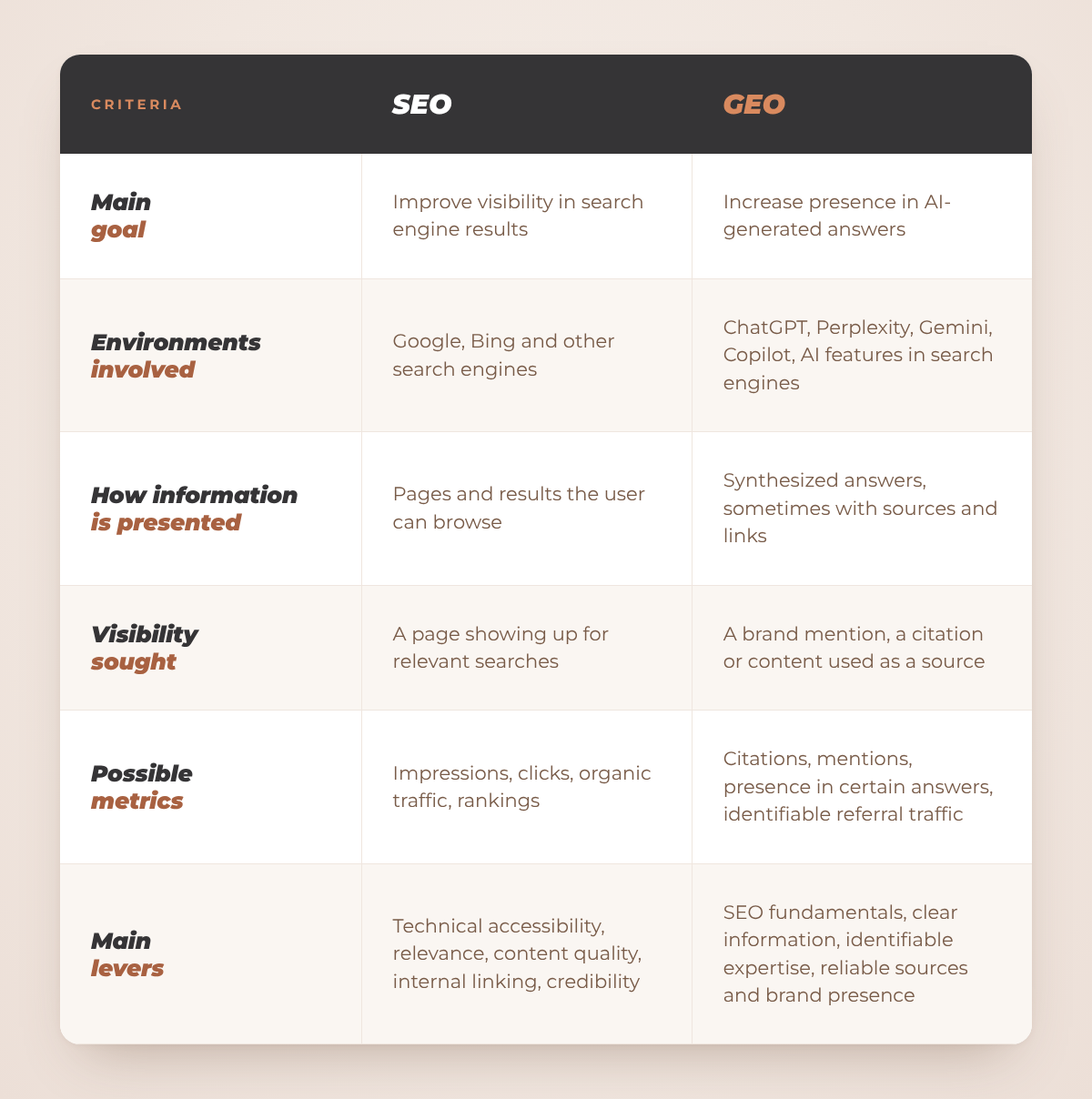
In the end, the most important distinction is how the user gets to the information.
With a classic search, they can scroll through several results, compare websites and pick the one they want to visit. With an AI-generated answer, part of that research and synthesis work is done by the system itself.
That doesn’t mean clicks are disappearing. Some AI answers link to their sources, and users can still visit websites to dig deeper, check a claim or discover a company.
In fact, the line between SEO and GEO is getting blurrier as Google evolves. Its AI Overviews and AI Mode features bring generative answers right into the search experience. In October 2026, Google also announced changes meant to make links and sources more visible in those answers.
In other words, these aren’t two completely separate worlds. Traditional search engines are integrating AI too.
And how do you measure results?
That’s another big difference.
In SEO, tools like Google Search Console let you track impressions, clicks and page performance in search results.
For GEO, measurement is even less consistent. You can spot some citations or mentions, but there’s no single dashboard that accurately measures a brand’s presence across every AI answer.
Since 2026, Bing Webmaster Tools has offered an AI Performance report, for example, which shows page citations in Microsoft Copilot, Bing’s AI summaries and some partner experiences. It’s an interesting step forward, but a citation doesn’t necessarily mean a click or a visit to your site.
So avoid comparing a Google ranking with a citation in an AI answer directly: they’re not the same metrics.
Wondering whether your content is really ready for these new search journeys? Before piling on optimizations, the most useful thing is often to understand what already works and what deserves to be improved.
Will GEO replace SEO?
No. And honestly, I think pitting them against each other misses the point.
The rise of AI-assisted search changes how people discover information and businesses. But it doesn’t make the fundamentals of organic search useless.
On the contrary, several principles remain essential in both approaches: offering relevant information, making your content accessible, matching search intent and building credibility.
Google says so in its official documentation: its AI Overviews and AI Mode features rely on existing SEO best practices. You don’t need special markup or special files to appear in them.
That’s an important point, because GEO has also brought a wave of recommendations presented as must-haves, even though they’re not always backed by solid evidence.
It’s also worth remembering that not everyone uses the same tools, or uses them the same way. Some people still run classic Google searches. Others ask an AI directly. And many switch between sources depending on what they need.
Someone might discover a problem through an AI-generated answer, then search on Google to compare providers. Or do the exact opposite.
For a business, the point isn’t to pick a side, but to understand how its audience looks for information and makes decisions.
Which SEO and GEO best practices matter in 2026?
Even as search environments evolve, some practices remain relevant to improve the quality and visibility of your content.
1. Answer your audience’s questions clearly
Effective content has to answer a real question first.
It sounds obvious, but there are still plenty of articles that circle around a topic without ever giving a precise answer.
In SEO and in GEO, clarity matters. If your reader wants to understand the difference between two concepts, they should be able to find it without reading fifteen paragraphs of introduction.
That doesn’t mean turning all your content into FAQs or only writing short answers. It just means adapting the structure and level of detail to what the person is actually looking for.
2. Bring expertise that AI can’t make up
Today, producing a generic article on a common topic has become incredibly easy. A few seconds are enough to generate a text that looks like plenty of others.
But does that content actually add anything?
That’s where human expertise really matters. Field experience, analysis, concrete examples, verifiable data and well-argued points of view go further than rephrasing information that’s already available everywhere.
And that’s also what can make a reader want to discover your company rather than another one.
To be clear, that doesn’t mean AI can’t help you create content. I use it myself in my work, especially for research, analysis or to challenge my own thinking. But it doesn’t replace knowledge of the industry, the client or the business context.
AI can be an excellent working tool. It shouldn’t become your only source of expertise.
3. Structure information without writing for robots
Clear headings, a logical flow, readable paragraphs and information that’s easy to find: these are good editorial practices before they’re SEO or GEO considerations.
A comparison table can help when you’re explaining differences. A list can make several recommendations easier to read. And a concrete example can make a technical idea much more accessible.
On the other hand, artificially adding FAQs, repeating keywords or chopping every sentence in the hope of pleasing algorithms isn’t worth much.
Structure should serve the content, not the other way around.
4. Take care of the credibility of your online presence
Your website isn’t the only place where your business exists.
What you say in public, your posts, your references, your professional profiles and the information available about your brand can also shape how your expertise is perceived and found.
The goal isn’t to be everywhere, but to build a clear and consistent identity.
If your company says one thing on its website, another on LinkedIn, and shows outdated information across its platforms, it can confuse the people discovering you.
On the flip side, consistent communication, backed by reliable information and recognizable expertise, is a strong foundation for your visibility.
It doesn’t guarantee AI will recommend you, but it’s already essential to earn people’s trust. And personally, I think that’s a very good reason to do it.
SEO or GEO: where should you invest first?
“Should I invest in GEO or stick with more traditional SEO?” It’s a question that comes up a lot right now. And I get it. But put that way, it suggests you have to pick one or the other.
It’s still probably the most interesting question for a business that doesn’t have an unlimited marketing budget.
And the answer mostly depends on where you are today.
If your site’s SEO foundations are still shaky, I’d start there. A site that’s hard to crawl, unclear pages or content that doesn’t match what your prospects search for won’t start performing just because you add a GEO layer to your strategy.
If you already have a good base of content, it can be worth looking at which pieces deserve to be updated, expanded or clarified. Not necessarily to rewrite everything, but to make them more useful and better at answering your audience’s questions.
If your prospects regularly use AI assistants to look for solutions, then GEO naturally deserves more attention. You can start observing how your company and your industry show up in these environments, while keeping a critical eye on the results.
Either way, I don’t recommend multiplying SEO and GEO actions without defining what they should bring to the business.
It’s a topic I cover in more depth in my article on building a content strategy aligned with your business goals. Before choosing tools and channels, you need to know where you’re going.
How do you integrate GEO into your SEO strategy?
Good news: you don’t need to build a second strategy next to the first one. GEO is more of an extension of the SEO work you’re already doing. If I had to give you a starting point, here’s how I’d go about it.
First, look at the pages that are already working. In Google Search Console, you can spot the ones that get impressions on searches related to your business. They’re often the ones most likely to be picked up elsewhere too, especially since several AI assistants partly rely on search engine results to build their answers.
Then, put yourself in your prospects’ shoes. Ask ChatGPT, Perplexity or Gemini the questions your clients ask you in meetings, and look at what comes up: which businesses get cited, which sources keep coming back, what’s missing from the answers. It’s not a perfect method, answers change from one try to the next. But it already gives you a good idea of how your topic is being covered.
From there, you can strengthen your content wherever the answers stay vague. A clearer definition, an example from your day-to-day work, a sourced figure, a well-argued opinion. That’s exactly what an AI can’t make up for you.
Also think about keeping your information consistent. If your website, your LinkedIn profile and your Google Business Profile describe what you do in the same way, your expertise becomes much easier to identify. For AI, but above all for the people discovering you.
Finally, when it comes to measuring, don’t mix everything up. Search Console to track your visibility in Google, Bing Webmaster Tools’ AI Performance report for citations in Copilot, and Google Analytics to spot visits coming from ChatGPT or Perplexity. These are three different metrics, and they don’t tell the same story.
Nothing revolutionary, I’ll admit. But that’s exactly what I find reassuring: integrating GEO is mostly about doing SEO with a bit more rigor on substance.
SEO and GEO: two complementary approaches to visibility
SEO and GEO don’t work in exactly the same way, but they share a common goal: helping a business and its content get discovered by the right people.
SEO remains essential to grow your visibility in search engines. GEO adds a new dimension, tied to AI-generated answers and the discovery journeys that come with them.
Still, there’s no need to start from scratch or chase every new technique sold as revolutionary.