
You publish articles on your blog, you’re active on LinkedIn and maybe you even send a newsletter.
On paper, your communication looks pretty complete.
But in reality, is all this content actually working together?
Between articles written for SEO, posts designed for social media and emails sent to your audience, you can quickly end up with three different strategies.
The result: you spend time producing content, but your messages go in every direction, topics repeat themselves and you’re no longer sure what each channel brings you.
That’s exactly why it’s worth building a content ecosystem: making sure your channels complement each other, instead of communicating everywhere with no common thread.
And the good news is, it doesn’t mean producing more.
Put simply: a consistent content ecosystem means giving each channel a clear job (your blog to get found, social media to start conversations, your newsletter to stay in touch) and moving the same ideas from one to the next. You don’t need to be everywhere. You need everything pointing in the same direction.
What is a content ecosystem?
A content ecosystem is all of a company’s content and channels, organized around shared goals and messages.
Being on several platforms isn’t enough. You need to know what each one brings to your communication and how they work together.
Take a company that has a blog, a LinkedIn page and a newsletter.
If it picks its topics separately for each channel, it risks producing a lot of content that has nothing to do with each other.
On the other hand, if it starts from its clients’ problems and its goals, it can create complementary content that looks at different sides of the same topic.
A consistent editorial ecosystem doesn’t depend on how many channels you use, but on the logic that connects them.
And that logic starts with one question: what is each channel for?
What role should your blog, social media and newsletter play?
Channels don’t all do the same job. And that’s exactly why they complement each other.
Of course, these roles aren’t set in stone.
A blog article can also help convince a prospect to get in touch. A LinkedIn post can generate a business opportunity. And a newsletter can perfectly well present an offer.
But knowing what each channel is good at keeps you from asking them all to do the same thing.
For example, your blog hosts in-depth content that answers specific searches on Google. Your social media introduces these topics to people who weren’t looking for them. And your newsletter keeps the conversation going with an audience that’s already interested in your expertise.
If you want to dig into the role of your blog in your visibility, I cover it in my article How can you be visible on Google and in ChatGPT answers?
You don’t need to move every reader from one channel to another. What matters is that they find useful content, wherever they discover you.
How do you build a consistent content ecosystem?
In a nutshell: start from your goals, pick a few channels, give each one a role, then carry every topic across them. Here’s how I’d go about it, step by step.
1. Start from your goals and your audience, not from channels
Before asking yourself how many LinkedIn posts or articles to produce each month, start by asking what you expect from your communication.
Getting known by a new audience? Building credibility in a market? Getting more inquiries? Staying in touch with your current clients?
Depending on your goals, you won’t cover the same topics, choose the same formats or give your channels the same role.
You also need to know who you’re talking to.
A small business owner looking for a solution to a specific problem doesn’t expect the same thing as someone who has been following you for months.
That’s why a content strategy should never start with a posting calendar.
I go into more detail in my article on building a content strategy aligned with your business goals.
Once that foundation is in place, it’s much easier to choose the channels that really matter for your business.
2. Define shared topics and messages
A consistent content ecosystem needs a common thread.
That doesn’t mean repeating the same messages everywhere. But over time, your content should paint a clear picture of your expertise and positioning.
To do that, pick a few key themes tied to your clients’ problems, your offers and what sets you apart.
Take a real estate agency.
It could build its communication around a few topics: home valuations, getting a property ready to sell, or the steps of buying a first home.
These themes can then be covered from different angles, depending on prospects’ questions and the goal of each piece.
Two benefits: you stop picking topics at random, and your communication becomes more consistent over time.
Your audience should be able to recognize your expertise, whether they discover you through an article, a LinkedIn post or a newsletter.
3. Adapt the same topic to each channel, without duplicating it
This is probably the most common mistake: thinking that being multichannel means publishing exactly the same content everywhere.
Yet people don’t expect the same thing when they search on Google, scroll through LinkedIn or open a newsletter.
Let’s take a concrete example.
Let’s go back to our real estate agency: it wants to help homeowners sell at the right price.
It could turn this topic into three pieces of content:
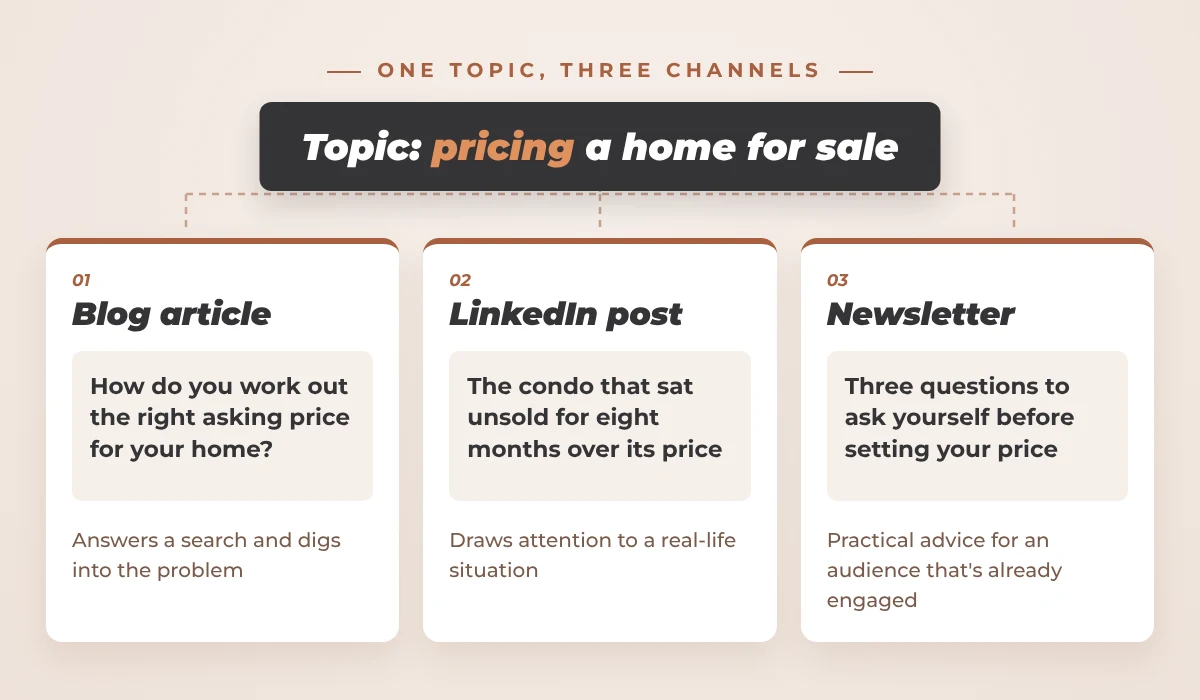
It’s the same topic, but each piece of content brings something different.
The article answers a search and explores the problem in depth. The LinkedIn post draws attention to a concrete situation. The newsletter offers practical advice to an audience that’s already engaged.
And above all, you don’t need to create three pieces of content for every idea.
Some topics deserve a full article. Others work better as a LinkedIn post or an email.
The goal is to make the most of your expertise, not to artificially multiply formats.
Using several communication channels, but lacking consistency between your content? I help you build an editorial strategy that connects your goals, your expertise and the right channels, without making you be everywhere.
4. Build bridges between your content
Once your content is created, there’s one step people often forget: thinking about how the pieces connect.
A blog article can explore a question raised in a LinkedIn post. A newsletter can recommend a resource published on your website. And an article can invite interested readers to subscribe to your newsletter for more advice.
These bridges keep the relationship going with your audience, without making them start from scratch with every new piece.
But that doesn’t mean adding a link to your website in every post.
Sometimes a LinkedIn post stands on its own. Sometimes it’s useful to point to a more detailed resource. It all depends on what you want to give the reader.
It’s actually what I do for my own communication: on my blog, I dive deeper into content strategy topics, and my LinkedIn profile is where I share thoughts, experiences and points of view about my work.
The formats are different, but they all talk about the same thing: content and what it can do for a business.
To go further, Google’s documentation on helpful content also reminds us that content should be designed first for the people who will read it. And that goes for every channel.
The mistakes that make your multichannel communication inconsistent
Building a content ecosystem doesn’t require a complicated setup. But some habits can quickly throw everything off.
Being everywhere without knowing why. A company doesn’t need a blog, a newsletter, a podcast and five social networks to communicate well. A few well-chosen channels with clear goals beat being everywhere and not keeping up.
Copy-pasting the same content without adapting it. A topic can be reused, but the same text won’t work everywhere. Each channel has its own codes and expectations.
Producing content that never connects. If your articles, posts and emails cover topics unrelated to your positioning, your audience may struggle to understand what your expertise is.
And I’d add one more: trying to build an ecosystem that’s too ambitious for your resources.
A strategy is useless if you can’t actually apply it. If you don’t have the time or resources to feed three channels properly, you’re better off keeping two and making them work together.
Fewer isolated pieces, more consistency
Building a consistent content ecosystem isn’t about being everywhere, or turning every idea into five different formats.
It’s mostly about knowing what you want to say, who you’re talking to and how each of your channels can support your goals.
Your blog, your social media and your newsletter can complement each other really well, as long as each one has a role and they’re connected.
And sometimes, the best decision isn’t to add a channel, but to make better use of the ones you already have.